How to Read a Roof Inspection Report Step by Step
A roof inspection report is useful when it separates what the inspector observed from what the observation may mean, documents the method and limitations, and gives the client a clear next step. It should not be read as a promise that every concealed condition has been found or as a precise forecast of remaining service life.
This explainer shows how to review a residential roof section inside a home inspection report. It focuses on scope, terminology, photos, priorities and follow-up. It does not replace the signed inspection agreement, a specialist evaluation or advice for a specific property. Confirm ASM's current service context on the ASM Home Inspection website.

Find the report scope before reading findings
Start with what the inspection included. The InterNACHI Home Inspection Standards of Practice describe a home inspection as a visual, non-invasive examination. Its roof section includes roof-covering materials, gutters and downspouts, visible flashings, skylights, chimneys, roof penetrations and the general roof structure from readily accessible areas.
The American Society of Home Inspectors Standard of Practice is a separate professional reference that also connects a written report with inspected systems, observed conditions and limitations. These standards provide general reading context; the signed agreement and the actual report define the scope for a particular inspection.
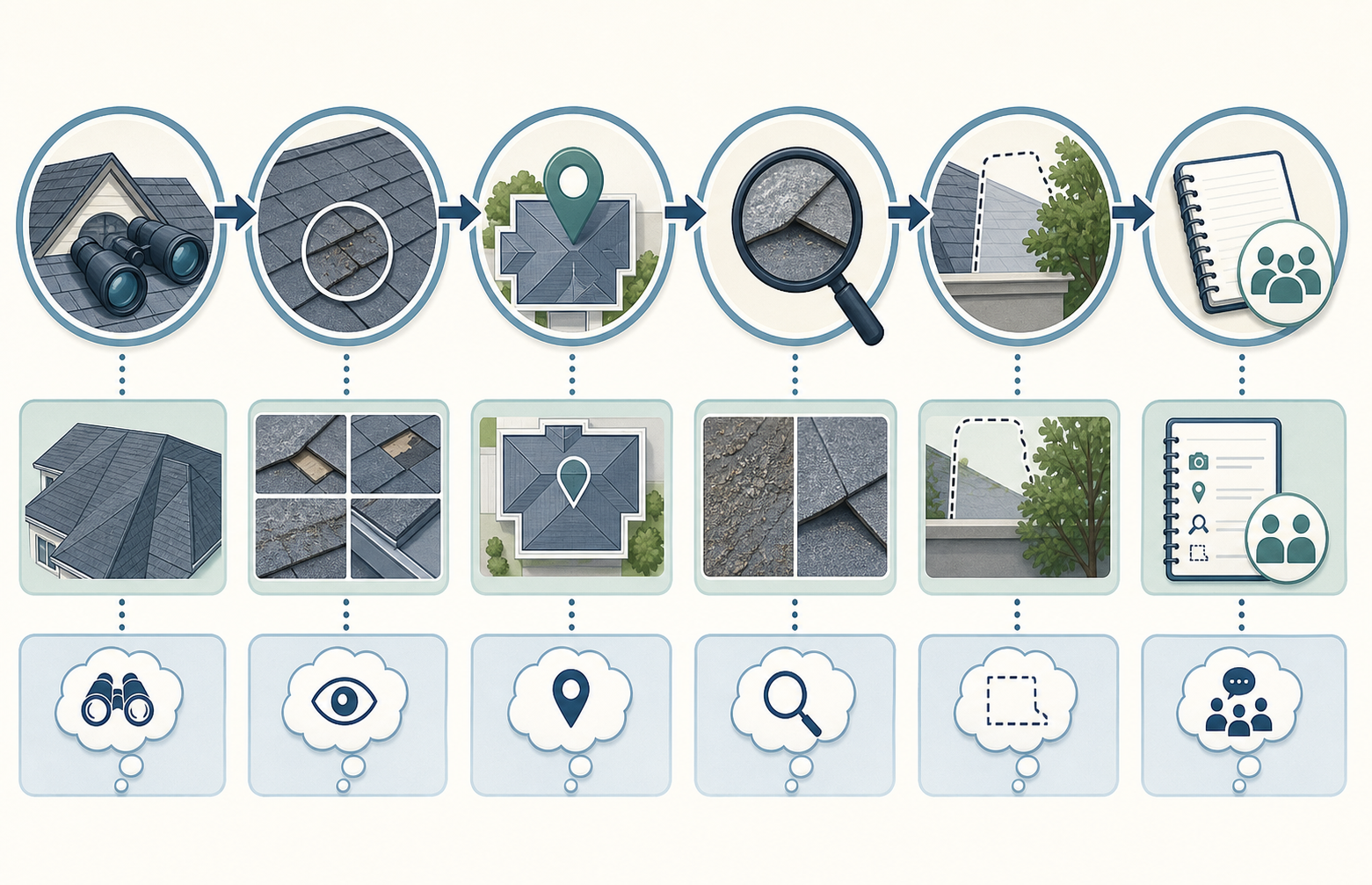
The report should identify how the roof was observed. That might include walking an accessible surface, viewing from the ground, using a ladder at the eaves, looking from a window or using another stated method. The method affects what could be seen. A report should not imply that inaccessible or concealed areas received the same review.
Read the exclusions too. Snow, height, steepness, wet surfaces, fragile materials, limited access and personal safety can restrict the inspection. A limitation is important decision information, not a minor footnote.
Separate four layers of report language
| Layer | Question it answers | Example structure |
|---|---|---|
| Observation | What was visible? | A lifted edge was observed at a named roof area. |
| Location | Where exactly? | Rear slope near the plumbing vent. |
| Implication | Why might it matter? | The condition may increase exposure to water entry. |
| Recommendation | What happens next? | Have the area evaluated and corrected by an appropriate roofing professional. |
When those layers are blended into one vague sentence, ask for clarification. “Roof is old” offers less decision value than a located observation, relevant implication, inspection limitation and follow-up recommendation.
Review the roof covering section
The report should identify visible covering materials where possible and describe observed conditions. Common report language may address missing, cracked, curled, lifted, worn, loose or damaged components, exposed fasteners, patching or inconsistent installation. The meaning depends on material, extent and location.
A photo should show context as well as detail. A close image of one damaged area is stronger when another image or caption locates it on the building. Check whether the finding is isolated, repeated or widespread.
Do not translate appearance directly into remaining life. Weather exposure, installation, ventilation, maintenance and concealed conditions all matter. If a decision depends on service life or replacement scope, obtain a specialist assessment.
Check flashings and penetrations carefully
Roof changes and openings deserve specific attention. Reports may address visible flashing at walls, valleys, chimneys, skylights, vents and other penetrations. Look for a location, observed condition and the recommended follow-up.
Staining near a penetration can be relevant, but the report should avoid claiming a concealed source without evidence. Water can travel from another location before it appears inside. A specialist may need to test or open areas that a visual home inspection cannot.
Read the drainage findings as a system
Gutters and downspouts influence how water moves away from the roof edge and building. A report may note debris, damage, loose sections, poor discharge location or evidence of overflow. The roof surface, drainage components and grading can interact.
Ask whether the observation was made during rainfall or in dry conditions. A dry visual inspection can identify conditions but may not demonstrate how the system behaves during a storm. The report should state what was actually observed.
Connect exterior and interior evidence
Roof reporting is stronger when exterior observations are compared with accessible attic or interior conditions. The report may describe visible staining, moisture evidence, damaged sheathing, insulation conditions, ventilation observations or signs of previous repair.
A stain does not prove active leakage at the time of inspection. The report should say whether moisture was observed or measured, whether the area was dry, and what limitation applies. Ask how an interior condition relates to the exterior location.
Understand priority labels
Inspectors use different rating systems. One report may use major, repair and monitor; another may use immediate, near-term and maintenance. Find the legend before sorting findings. A red icon has no meaning without the report's definition.
Priority should consider consequence and urgency, not only repair size. A small opening near a critical penetration can deserve prompt attention even if the visible repair appears limited. Conversely, an aged appearance may call for planning rather than an emergency response.
Create three follow-up lists:
- Safety or active-damage concerns: clarify immediately with the inspector and appropriate professional.
- Further evaluation: obtain specialist information before a transaction or project decision.
- Maintenance and monitoring: record the location, action and future review point.
Use photos as evidence, not decoration
Each important image should have a useful caption or nearby narrative. Look for the roof side, slope, component and direction. Arrows or circles can help, but they should not hide the surrounding context.
When a photo is unclear, ask the inspector to explain what it demonstrates. Do not assume that every photo is a defect. Reports often include reference images to document materials, access method or general condition.
Pay attention to report limitations
Limitations define the boundary of the opinion. Common examples include no access to the roof surface, snow coverage, stored items, finished ceilings, low attic clearance or inaccessible additions. Note which important decisions remain unresolved because of that boundary.
A strong limitation should be specific. “Roof not inspected” is less useful than a statement describing the method used, area not observed, reason and recommended next step.
Questions to ask after reading the report
- Which roof areas were directly observed, and by what method?
- Which areas or components were not accessible?
- Which findings are material defects under the report's definitions?
- Where is each condition located?
- Was any moisture observed or measured at the inspection?
- Which item needs specialist evaluation, repair, maintenance or monitoring?
- Does a recommendation address the cause, the symptom or both?
- Which findings may affect a current transaction decision?
- What documentation should be requested from the seller or contractor?
- What should be checked again after work is complete?
Compare a home inspector and a roofing specialist
A home inspector provides a broad, visual assessment across the property within the inspection agreement. A roofing specialist can be asked to investigate a particular roof condition, repair method or replacement scope. One role does not automatically replace the other.
Use the home inspection report to identify and locate concerns. Use a specialist when the report recommends further evaluation, a concealed cause needs investigation, a repair scope is required or a major decision depends on material-specific expertise.
Turn findings into a follow-up log
| Report item | Location | Priority | Next step | Evidence to keep |
|---|---|---|---|---|
| Copy the exact finding | Roof side and component | Use the report legend | Clarify, evaluate, repair or monitor | Photo, quote, invoice or follow-up note |
| Copy the exact finding | Attic or interior area | Use the report legend | Compare with exterior evidence | Moisture note and specialist response |
Keep the original report unchanged. Put questions and later work in a separate log so the inspection-day observations remain distinct from later information.
Date every follow-up entry and name the person or company that supplied the new information. This preserves a clear sequence for future owners and advisors.
Roof report red flags to avoid
- No stated inspection method
- Vague findings without a location
- Photos without captions or context
- A precise remaining-life prediction without supporting evidence
- Concealed-condition conclusions from a visual review alone
- No explanation of priority labels
- Recommendations that do not identify the appropriate next step
- Important limitations hidden away from the related finding
What a roof inspection report cannot establish
A standard visual report cannot reveal every concealed defect, predict future weather, promise a leak-free roof or define a complete repair scope. It also may not determine code compliance or the cause of every stain. Read the agreement and report definitions for the exact service.
Do not climb onto a roof to verify a photo. Falls, fragile surfaces, electrical hazards and weather make roof access a professional decision. Ask the inspector or an appropriate roofing professional for clarification.
Frequently asked questions
Should a roof report include photos?
Photos can improve location and context, but the written observation, implication, limitation and recommendation still matter. An image alone may not explain the finding.
Does a roof inspection report say how long the roof will last?
It may describe age information or visible condition, but remaining life is uncertain. Ask what evidence supports any planning estimate and whether specialist evaluation is recommended.
What does further evaluation mean?
It means the home inspection did not or could not resolve an issue within its scope. The report should identify the type of professional or investigation needed.
Is a roof inspection the same as a home inspection?
A home inspection covers many systems and includes a roof section. A roof-focused specialist assessment may provide more material-specific investigation or project scope.
What should I do with minor findings?
Record them in the follow-up log, complete recommended maintenance and monitor the named location. Small findings should not disappear from the property record.
Contact ASM Home Inspection for the next report step
A useful roof inspection report shows what was inspected, how it was viewed, what was observed, where it is located, why it matters, what was limited and what should happen next. Read those parts together rather than relying on a summary icon or one photo.
Authoritative sources reviewed
- ASM Home Inspection website — current first-party service and inquiry context.
- InterNACHI Home Inspection Standards of Practice — visual scope, roof components, reporting and limitations.
- ASHI Standard of Practice — an additional professional reference for written inspection scope and reporting.