A year-over-year home evidence guide
Turn an Annual Home Inspection Into a Change Record
Short answer. Make an annual inspection useful by comparing the home with a dated baseline, not by creating a fresh list with no history. Record the same locations, photos and observations each year. Separate what was seen from what it might mean. Assign each item to monitor, maintain, investigate, obtain specialist review or address urgently. A general visual inspection has important limits and cannot prove that concealed systems are safe or defect-free.
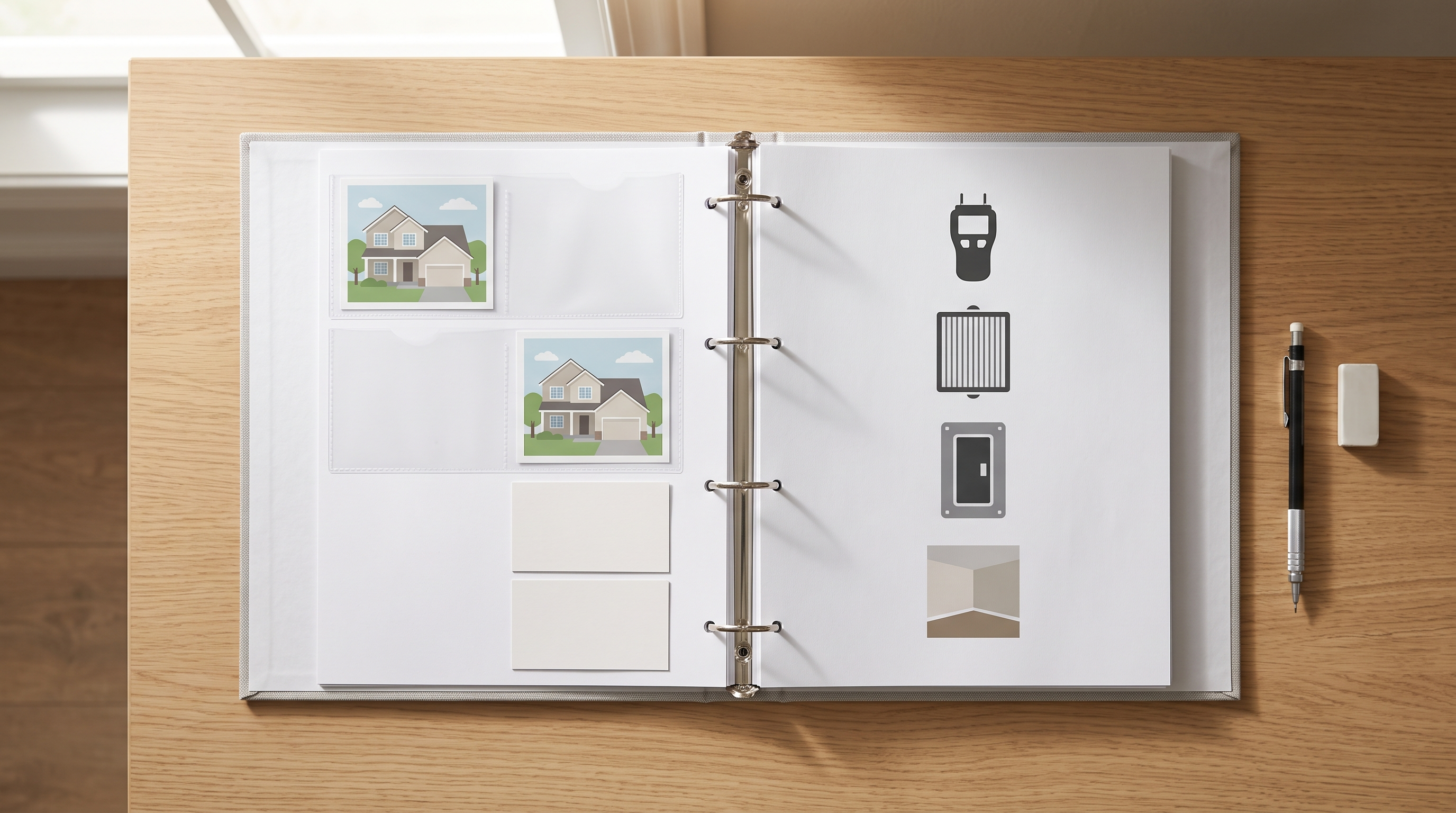
A repeatable annual record is most useful when photos, locations, dates and follow-up decisions can be compared from one year to the next.
Define what the annual inspection is meant to do
An annual inspection can support maintenance planning by showing what has changed since the last review. It is not automatically a code inspection, engineering assessment, environmental test, energy audit, repair estimate or guarantee. Define the property, areas, access, report format and exclusions before comparing results.
Choose a repeatable season when practical, because snow, rain, vegetation, temperature and occupied conditions affect what can be observed. Record major renovations, leaks, storms, appliance changes and repairs since the last review. Those events help explain why a location deserves attention without predetermining a diagnosis.
ASM Home Inspection's public home and commercial inspection page lists inspection context and item categories. Confirm whether an annual maintenance inspection is currently offered and request the exact scope, access, exclusions, credentials, service area, price and report format.
Assemble a baseline before walking the property
Gather the prior report, dated photos, repair invoices, manuals, service records, permits where applicable, warranties, utility concerns and unresolved recommendations. Create a simple property map so the same wall, window, roof edge, drain, mechanical unit and interior area can be found again.
- Label every observation with date and exact location.
- Keep the original photo and add a similar-angle comparison.
- Record weather and access limitations.
- Note work completed since the earlier image.
- Carry forward unresolved items and their last action.
A baseline should preserve evidence, not make an old conclusion permanent. If conditions or standards change, the current reviewer should explain the new interpretation.
Review the home in the same practical zones
Start outside when it is safe: site drainage, grading, visible foundation, wall finishes, windows, doors, decks, railings, exterior penetrations, roof edges visible from safe locations, gutters and downspouts. Do not climb or enter unsafe areas simply to complete a template.
Inside, organize observations by level and system: visible water staining, finishes, windows and doors, plumbing fixtures, electrical components that are within the agreed visual scope, heating and cooling equipment, attic or crawlspace only when safely accessible, and life-safety devices as defined by the inspection or maintenance plan.
Health Canada's guide to addressing moisture and mould emphasizes controlling moisture and repairing water entry. If moisture, odour or visible growth is observed, record location and extent without guessing the cause or health effect.
Record observed change without turning it into a diagnosis
Use neutral language: “discolouration is wider than in the dated image” is more useful than “roof leak” when the source has not been established. Measure only when it can be done safely and consistently. Note whether a condition is new, stable, improved, repaired, inaccessible or not comparable.
| Record field | Useful entry | Avoid |
|---|---|---|
| Observation | What is visible, audible or reported | An unsupported cause |
| Location | Room, wall, elevation or component | “Somewhere downstairs” |
| Comparison | New, stable, changed or inaccessible | “Probably always like that” |
| Evidence | Dated photo, record or measurement method | An edited image with no original |
| Next owner | Homeowner, inspector, contractor or specialist | No accountable follow-up |
Convert the record into a priority decision
Priority should combine potential consequence, rate of change, evidence confidence and who is qualified to assess the issue. A rapidly changing water condition may deserve faster investigation than a stable cosmetic mark, even when neither cause is known. Immediate hazards or active emergencies require the appropriate emergency response rather than an annual-report workflow.
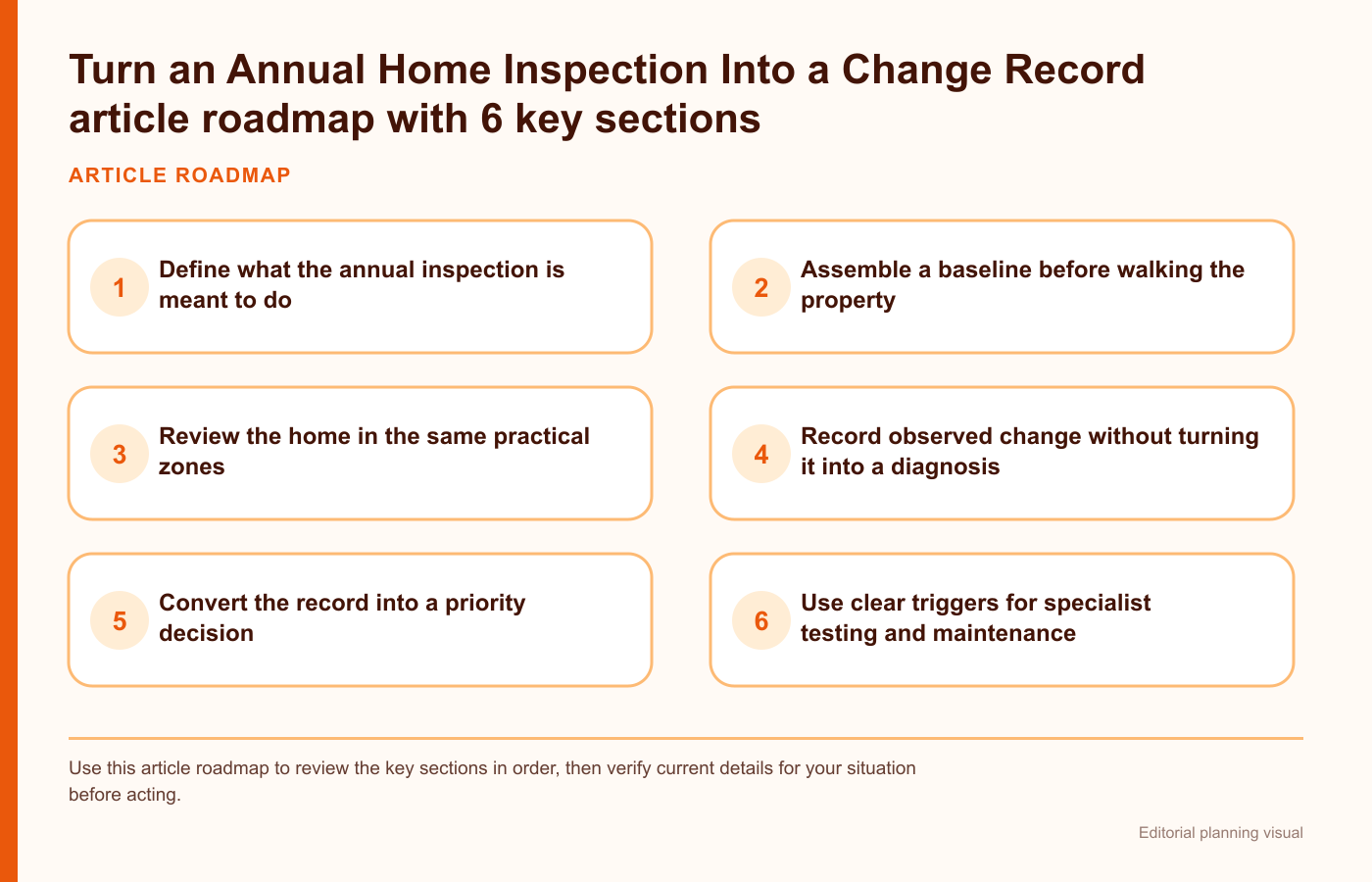
Use this article roadmap to review the key sections in order, then verify current details for your situation before acting.
| Category | Use when | Record next |
|---|---|---|
| Monitor | Evidence is stable and no urgent concern is identified | Photo angle and review date |
| Maintain | A routine owner or contractor task is verified | Owner, instructions and completion record |
| Investigate | Cause or extent remains uncertain | Question, access needed and qualified reviewer |
| Specialist review | Issue falls outside the inspection scope or expertise | Discipline, urgency and records to share |
| Urgent response | There may be an immediate safety or active-damage concern | Stop exposure and contact appropriate help |
Use clear triggers for specialist testing and maintenance
A visual annual inspection should not stand in for services that require instruments, licences, invasive access or subject expertise. Radon is a good example: it cannot be confirmed by sight or smell. Health Canada says long-term radon testing should run for at least three months and describes DIY and certified-provider options.
Heating and cooling systems also need their own service plan. Natural Resources Canada publishes guidance on maintaining home heating and cooling systems and recommends annual pre-season check-ups by a licensed and insured contractor. An inspector's observation should not be represented as equipment servicing.
Other triggers may involve structural engineering, electrical or gas expertise, plumbing diagnosis, roofing, environmental assessment, pest control, chimney service or municipal guidance. Choose the discipline based on the unresolved question, not a generic list.
Understand the limits before acting on the report
Conditions can be concealed by walls, finishes, stored items, insulation, snow, furniture or inaccessibility. Equipment can fail after an inspection. A component operating during a short observation is not guaranteed to continue operating. A general report may identify a concern without determining its cause, code status, remaining life or repair method.
Ask the inspector to distinguish inspected, not inspected, inaccessible and outside scope. Ask how urgent language was determined and what qualified next step is recommended. If the service includes no technical testing, do not infer test results from silence.
Close the annual cycle with evidence
- Review priority items and assign an owner.
- Set a date or event trigger for follow-up.
- Save specialist reports and repair records.
- Photograph completed work without claiming performance.
- Update the property map and unresolved list.
- Schedule the next comparison in a similar season.
The record becomes more valuable when decisions and completed actions are traceable. Keep old versions; deleting a resolved observation removes useful context.
Annual home inspection mistakes to avoid
- Starting a new checklist each year without carrying forward history
- Writing a diagnosis where only an observation exists
- Using a visual review as proof of code compliance or safety
- Entering a roof, attic, crawlspace or electrical area unsafely
- Leaving specialist recommendations without an owner or date
- Confusing equipment observation with licensed servicing
- Quoting credentials, prices or service areas that have not been verified
Frequently asked questions
Is an annual home inspection required?
Requirements vary by property and context. This guide describes a voluntary maintenance record, not a legal requirement. Confirm obligations with the appropriate authority.
Does an annual inspection replace home maintenance?
No. It can help organize observations and follow-up, but manufacturer instructions, specialist service and routine maintenance remain separate.
Can a visual inspection find mould or radon?
It may record visible moisture or growth, but it cannot establish hidden conditions or radon levels. Use official guidance and qualified testing or assessment.
Should I use the same inspector every year?
Continuity can help, but scope, competence, independence and reporting quality still matter. A clear baseline should be usable by another qualified reviewer.
Request a scoped annual inspection next step
Prepare the last report, dated photos, repair records, property map and unresolved questions. Then return to ASM Home Inspection's current contact and service information to request the actual annual-inspection scope, exclusions, access, report format and qualifications. Confirm property-specific technical advice with the appropriate professional before acting.